

In a photovoltaic power station, the energy of a large number of components must be pooled to enter the inverter, depending on cables and connectors, the solar connector is the key part of the interconnection among the components, Bus Box, controller and inverter in the PV power generation system.


01
History of solar connectors
History of solar connectors
For solar connectors, 1996 and 2002 are two very important years. Before 1996, there were no special solar connectors. PV cables were connected by a universal screw terminal or splice connection with an insulating tape, which was time-consuming, laborious and unreliable, with the increasing installation of photovoltaic systems, it is desirable to have a fast, secure and easy-to-operate connectivity solution.
In 1996, a new type of plug-in connector (plug-in Connector) was developed based on these application environments and market demands. It was invented by the Swiss company Multi-Contact (incorporated into Staubier in 2002) , MC stands for brand and 3 is the diameter of the metal core. The main body of the MC3 is made of TPE material (Thermoplastic elastomer) and is physically connected by friction. MC3 more importantly, its connection system uses MULTILAM technology to guarantee the persistent stability of the connection.

In 2002, the birth of MC4 redefined photovoltaic connector, it is true to achieve the “Plug and play.”. The insulation is made of hard plastic (PC/PA) and is designed to be easier to assemble and field install. After MC4 appears on the market, get market approbate quickly, become the standard of solar connector gradually.

MC4 connector is divided into line end and board end, in a common sense, we say MC4 refers to the line end. MC4, by the metal parts and insulation of the two major components. MC is short for Multi-Contact and 4 is the diameter of the metal core.
Connectors from different manufacturers are not identical in terms of specifications, dimensions and tolerances, so there is no 100% match at all. If they are inserted into each other forcibly, the temperature will rise, the contact resistance will change and the IP grade can not be guaranteed, which will seriously affect the efficiency and safety of resistance generation.
Because Multi-Contact is the world’s first professional photovoltaic connector, many standards are set by it, the impact is huge, many people mistakenly thought that the foreign name of the photovoltaic connector is MC4, in fact, it is not, the other is the photovoltaic connector Amphenol/Amfenol, shipping volume is similar to this, model Heliosh4.
In 1996, a new type of plug-in connector (plug-in Connector) was developed based on these application environments and market demands. It was invented by the Swiss company Multi-Contact (incorporated into Staubier in 2002) , MC stands for brand and 3 is the diameter of the metal core. The main body of the MC3 is made of TPE material (Thermoplastic elastomer) and is physically connected by friction. MC3 more importantly, its connection system uses MULTILAM technology to guarantee the persistent stability of the connection.

In 2002, the birth of MC4 redefined photovoltaic connector, it is true to achieve the “Plug and play.”. The insulation is made of hard plastic (PC/PA) and is designed to be easier to assemble and field install. After MC4 appears on the market, get market approbate quickly, become the standard of solar connector gradually.

MC4 connector is divided into line end and board end, in a common sense, we say MC4 refers to the line end. MC4, by the metal parts and insulation of the two major components. MC is short for Multi-Contact and 4 is the diameter of the metal core.
Connectors from different manufacturers are not identical in terms of specifications, dimensions and tolerances, so there is no 100% match at all. If they are inserted into each other forcibly, the temperature will rise, the contact resistance will change and the IP grade can not be guaranteed, which will seriously affect the efficiency and safety of resistance generation.
Because Multi-Contact is the world’s first professional photovoltaic connector, many standards are set by it, the impact is huge, many people mistakenly thought that the foreign name of the photovoltaic connector is MC4, in fact, it is not, the other is the photovoltaic connector Amphenol/Amfenol, shipping volume is similar to this, model Heliosh4.
02
The core technology of solar connector
The core technology of solar connector
The connectors must be able to adapt to long-term exposure to wind, rain, hot sun and extreme temperatures. They not only need to be waterproof, heat-resistant and weather-resistant to ultraviolet rays, but also need touch protection, high current-carrying capacity and high efficiency. At the same time, low contact resistance is also an important consideration. All of this, too, must run through the life cycle of a photovoltaic system for at least 25 years.
(1) enclosure insulation
solar connectors are generally used in harsh environments, ranging from coastal saline lands to highland deserts, from hot equatorial regions to cold, high-latitude regions, as well as perennial erosion by solar radiation, rain and snow, and wind and sand, the weather resistance, heat resistance, flame retardancy, mechanical properties, insulation and other properties of the insulation material are very good, can only be used for 25 years, to ensure the inside of the copper core and the outside insulation.
(2) sealing
Inside the solar connector is the plug-in copper core and the copper core of the cable, which itself has no anticorrosion function and needs the connector to keep the copper core isolated from the outside world. The on-board connector is also with the inverter (or controller) , so also to ensure that the inverter sealing function, so the connector sealing function should be very reliable. In addition to the installation, the sealing screw to tighten.
(3) contact resistance
IEC 62852 is the latest international standard for solar connectors. The increment of the contact resistance between the male and the female after insertion should not be more than 5m ω or the terminal resistance should be less than 150% of the initial value. Using high-quality solar connector, the power consumption on the connector is less than 10,000 of the total power of the system, poor quality connector power consumption is more than 30 times the high-quality connector. The basic cause of connector failure and fire: the increase of contact resistance of connector leads to the increase of temperature under the current condition, which is beyond the temperature range of plastic shell and metal parts. Contact resistance and copper core materials, size, different brands of connectors, specifications are not the same, it is recommended not to mix. In the installation, male and female connectors to plug into place, the formal brand of connectors, the plug into place when there will be sound.
(1) enclosure insulation
solar connectors are generally used in harsh environments, ranging from coastal saline lands to highland deserts, from hot equatorial regions to cold, high-latitude regions, as well as perennial erosion by solar radiation, rain and snow, and wind and sand, the weather resistance, heat resistance, flame retardancy, mechanical properties, insulation and other properties of the insulation material are very good, can only be used for 25 years, to ensure the inside of the copper core and the outside insulation.
(2) sealing
Inside the solar connector is the plug-in copper core and the copper core of the cable, which itself has no anticorrosion function and needs the connector to keep the copper core isolated from the outside world. The on-board connector is also with the inverter (or controller) , so also to ensure that the inverter sealing function, so the connector sealing function should be very reliable. In addition to the installation, the sealing screw to tighten.
(3) contact resistance
IEC 62852 is the latest international standard for solar connectors. The increment of the contact resistance between the male and the female after insertion should not be more than 5m ω or the terminal resistance should be less than 150% of the initial value. Using high-quality solar connector, the power consumption on the connector is less than 10,000 of the total power of the system, poor quality connector power consumption is more than 30 times the high-quality connector. The basic cause of connector failure and fire: the increase of contact resistance of connector leads to the increase of temperature under the current condition, which is beyond the temperature range of plastic shell and metal parts. Contact resistance and copper core materials, size, different brands of connectors, specifications are not the same, it is recommended not to mix. In the installation, male and female connectors to plug into place, the formal brand of connectors, the plug into place when there will be sound.
03
Crimping method of solar connector
Crimping method of solar connector
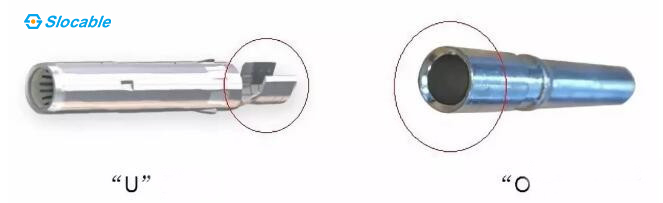
Metal core type and characteristics: metal core is the main component of the connector, but also the main current through the path. At present there are two kinds of solar connectors on the market, one is “U”-type metal core, which is formed by copper sheet stamping, also known as stamping-type metal core, suitable for automated wire harness production. Another part of the photovoltaic connector using “O”-type metal core, it is fine copper rod drilling at both ends of the molding, also known as machining-type metal core. “O”type metal core connection reliable, low requirements for crimping tools. It is suitable for production with manual crimping tools.
There is also a very rare metal core is pressure-free, it relies on the spring and cable connection. Since no crimping tool is required, the installation is relatively simple and convenient. However, spring-leaf connections can lead to high contact resistance and can not guarantee long-term reliability. Some certification bodies do not approve of such metal cores.
(1) basic knowledge of crimping
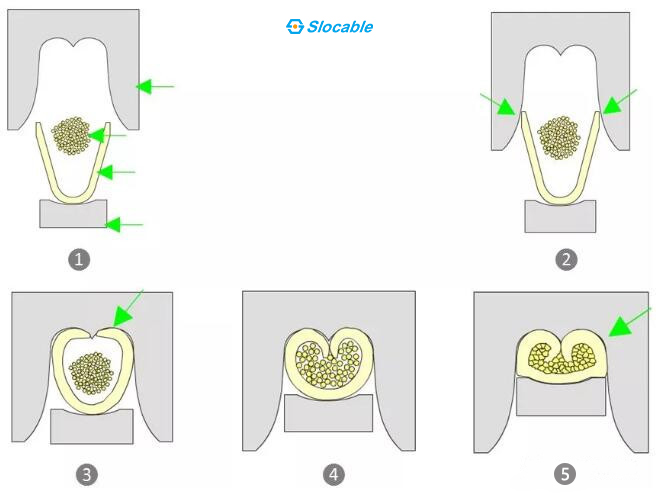
Crimp is one of the most basic and common bonding techniques. The reliability of crimping depends largely on the tool and operation, which together determine whether the final crimping effect meets the requirements of the standard. Take the “U”type metal core, which is basically copper-tinned material and needs to be connected by a crimping and photovoltaic cable. The crimping process is as follows:
It is not difficult to see, “U”-type metal core compression is a compression with the compression height gradually reduced (while the compression force gradually increased) , copper wrapped cable wire gradually compression process. In this process, the control of crimping height directly determines the quality of crimping.
(2) crimp quality evaluation
The usual way of judging in the industry is as follows:
A, crimp height/width, within the defined range, measurable by vernier caliper;
B, pull force, that is to pull the copper wire from the crimp joint or pull off the force required, such as 4MM2 cable, IEC60352-2 requirements of at least 310n;
C, resistance, take 4mm2 cable as an example, IEC60352-2 requires that the crimp junction resistance is less than 5m ω;
D, cross-section analysis, non-destructive cutting crimp zone, analysis of width, height, compression ratio, symmetry, with or without cracking and burrs;
There is also a very rare metal core is pressure-free, it relies on the spring and cable connection. Since no crimping tool is required, the installation is relatively simple and convenient. However, spring-leaf connections can lead to high contact resistance and can not guarantee long-term reliability. Some certification bodies do not approve of such metal cores.
(1) basic knowledge of crimping
Crimp is one of the most basic and common bonding techniques. The reliability of crimping depends largely on the tool and operation, which together determine whether the final crimping effect meets the requirements of the standard. Take the “U”type metal core, which is basically copper-tinned material and needs to be connected by a crimping and photovoltaic cable. The crimping process is as follows:
It is not difficult to see, “U”-type metal core compression is a compression with the compression height gradually reduced (while the compression force gradually increased) , copper wrapped cable wire gradually compression process. In this process, the control of crimping height directly determines the quality of crimping.
(2) crimp quality evaluation
The usual way of judging in the industry is as follows:
A, crimp height/width, within the defined range, measurable by vernier caliper;
B, pull force, that is to pull the copper wire from the crimp joint or pull off the force required, such as 4MM2 cable, IEC60352-2 requirements of at least 310n;
C, resistance, take 4mm2 cable as an example, IEC60352-2 requires that the crimp junction resistance is less than 5m ω;
D, cross-section analysis, non-destructive cutting crimp zone, analysis of width, height, compression ratio, symmetry, with or without cracking and burrs;
For more information on pv cable connectors , please feel free to call Slocable at 86-769-22010201. You can also email us at pv@slocable.com.cn.


