

01
What is solar cable?
What is solar cable?
Solar cable is also a special photovoltaic cable, mainly used in photovoltaic power stations, with high temperature, cold, oil, acid and alkali resistance, anti-ultraviolet, flame-retardant environmental protection, long service life, and other advantages, mainly used in the environment under harsh weather conditions.
Solar cables are used in PV power systems to connect cables, such as parallel cables between groups and between groups to DC distribution boxes (bus boxes) , serial cables between PV modules and modules on DC side, cross-linking cables between modules and between modules and DC distribution boxes (bus boxes) and cables between DC distribution boxes and inverters, the utility model can also be applied to an AC application cable used for the connection between an inverter and a transmission network.
Photovoltaic cables are often exposed to sunlight, and solar systems are often used in harsh environmental conditions, such as high temperatures and UV radiation. In Europe, sunny days will cause the on-site temperature of the solar system to be as high as 100°C. Currently, the various materials we have available are PVC, rubber, TPE and high quality cross-link materials, but unfortunately there are rubber cables rated at 90°C, and even PVC cables rated at 70°C It is also often used outdoors. At present, the National Golden Sun Project is frequently launched. In order to save costs, many contractors do not choose special cables for solar energy systems, but choose ordinary pvc cables instead of photovoltaic cables. Obviously, this will greatly affect the use of the system life.
Slocable solar cable is made of stranded annealed tin-coated flexible copper wire, and the working temperature of conductor is 120 °C. The bending radius of the cable should be 6 times larger than the cable outer diameter. This product is a green halogen-free product. In case of fire accident, the quantity of poisonous and harmful gas and smoke is less.

Solar cables are used in PV power systems to connect cables, such as parallel cables between groups and between groups to DC distribution boxes (bus boxes) , serial cables between PV modules and modules on DC side, cross-linking cables between modules and between modules and DC distribution boxes (bus boxes) and cables between DC distribution boxes and inverters, the utility model can also be applied to an AC application cable used for the connection between an inverter and a transmission network.
Photovoltaic cables are often exposed to sunlight, and solar systems are often used in harsh environmental conditions, such as high temperatures and UV radiation. In Europe, sunny days will cause the on-site temperature of the solar system to be as high as 100°C. Currently, the various materials we have available are PVC, rubber, TPE and high quality cross-link materials, but unfortunately there are rubber cables rated at 90°C, and even PVC cables rated at 70°C It is also often used outdoors. At present, the National Golden Sun Project is frequently launched. In order to save costs, many contractors do not choose special cables for solar energy systems, but choose ordinary pvc cables instead of photovoltaic cables. Obviously, this will greatly affect the use of the system life.
Slocable solar cable is made of stranded annealed tin-coated flexible copper wire, and the working temperature of conductor is 120 °C. The bending radius of the cable should be 6 times larger than the cable outer diameter. This product is a green halogen-free product. In case of fire accident, the quantity of poisonous and harmful gas and smoke is less.

02
The difference between solar cable and common cable

1. Solar cables:
Conductor: copper conductor or tinned copper hundred conductor
Insulation: irradiance crosslinked polyolefin insulation
Sheath: irradiated cross-linked polyolefin insulation
2. Ordinary cable:
Conductor: copper conductor or tinned copper conductor
Insulation: polyvinyl chloride or XLPE insulation
Sheath: polyvinyl chloride
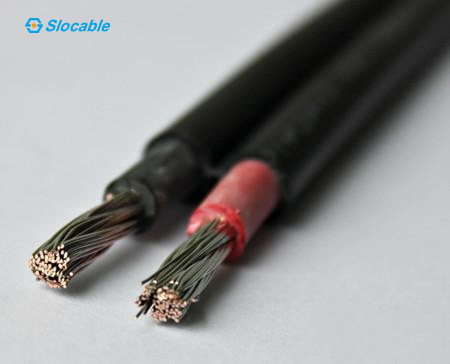
Common cable from the above can be seen using the same conductor and photovoltaic cable.Common cable insulation and sheath from the above can be seen different from photovoltaic cable. The various materials that ordinary cables can generally use are high-quality interwoven link materials such as polyvinyl chloride (PVC), rubber, elastomer (TPE) and cross-linked polyethylene (XLPE), but unfortunately, the highest rated temperature of ordinary cables. It is 90, and even PVC insulated cables with a rated temperature of 70 °C are often used outdoors, but they cannot meet the requirements of high temperature, UV protection, and cold resistance.The common cable is only suitable for laying in the common environment, but the solar cable is suitable for laying in the bad environment.
Since its establishment in 2008, Slocable has always focused on the research and development of safe and efficient photovoltaic products, striving to promote the healthy development of the industry.
For more information on solar cable, please feel free to call Slocable at 86-769-22010201. You can also email us at pv@slocable.com.cn.


