

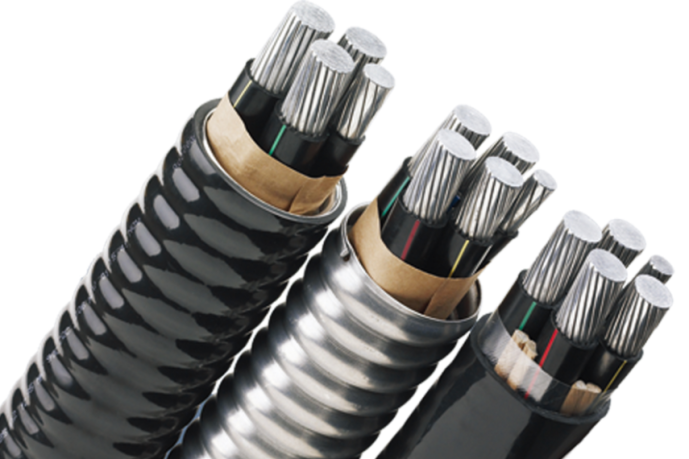
The cost control system is very important in the era of PV parity. The price of modules and inverters has fallen by 90 per cent over the past decade, contributing significantly to the overall cost of photovoltaic systems, but the cost of cables has not. In large projects, cables make up 10% of the system, more than inverters. In fact, as long as the design and installation is appropriate, under the premise of ensuring normal operation and safety of the system, part of the AC cable using aluminum alloy cable, can reduce part of the cost.

The cable of PV power station is divided into DC cable and AC cable, among which the DC cable between module and module and the DC cable between module and inverter, the cable from the inverter to the AC distribution cabinet, the cable from the distribution cabinet to the transformer, there is no requirement for what cable.
01
What is aluminum alloy cable
Aluminum alloy cable is a new type of power cable with AA8030 series aluminum alloy as conductor. The resistivity of aluminum alloy is between aluminum and copper, higher than copper, slightly lower than aluminum, at the same current carrying capacity, the same length of aluminum alloy conductor is only half the weight of copper.
Comparing the current carrying capacity of aluminum cable with that of copper cable, we can see that when the cross-sectional area of aluminum conductor is 1.5 times that of copper, aluminum cable achieves the same current carrying capacity, resistance and line loss as copper cable.
02
Service life
The metal surface reacts with oxygen to form different metal oxides. The oxide of aluminum can form a dense surface protective film with a certain hardness. Copper oxide commonly known as verdigris, between the two above, is a toxic substance.
03
Economic aspects
The cost of aluminum alloy cable is about 25% ~ 50% of that of copper core cable. We can make a comparison, in a 400kW village-level poverty alleviation power station, the distance from the AC distribution cabinet to the step-up transformer is 1500 meters, the maximum output current of the 400kW power station is 580A, if using copper cable, each phase needs two 150 square meters, the price is 864,000. If using aluminum alloy with two 240 square, the total length is 9,000 meters, the price is 450,000 yuan, and the loss of 240 square aluminum wire is lower than that of 150 square copper wire.
04
Precautions for use of aluminium cables
Copper has a melting point of 1080 °C, while aluminium and aluminium alloys have a melting point of 660 °C, so copper conductors are a better choice for fire-resistant cables. Now some aluminum cable manufacturers claim to be able to produce fire-resistant aluminum cable and passed the relevant national standard test, but aluminum cable and aluminum cable there is no difference, if in the center of the fire, that is, when the temperature is higher than the melting point of aluminum alloy and aluminum cable, the cable will melt in a very short time, no matter what kind of heat insulation measures are taken. Therefore, aluminum alloy should not be used as a conductor of fire-resistant cable, it is not suitable to be used in urban power distribution network, buildings, factories and mines with dense population.
Compared with the aluminum-cored cable, the copper core is flexible, the allowable bending radius is small, repeated bending is not easy to break, so more bends, more tubes or complex lines, aluminum cable should not be used.
Since the terminals of electrical switchgear are made of copper, the copper and aluminum are connected directly, and after electrification, the chemical reaction of the primary battery will occur: the more active aluminum will accelerate the oxidation, resulting in higher resistance at the junction and lower current carrying capacity, therefore, some measures should be taken to eliminate the electrochemical reaction, such as using copper-aluminum transition terminal or copper-aluminum transition bus.
For more information on PV cable, please feel free to call Slocable at 86-769-22010201. You can also email us at pv@slocable.com.cn.


